Showing posts with label Science. Show all posts

Sunday, 13 April 2014

Nail Polish flowers- technique and material testing

Every now and then I like to take a browse through Pintrest.  I find that it can be interesting to find ideas, but the big downside is that you see a lot of things repeatedly, find things listed in the wrong category (cooking recipies do NOT belong in the DIY and Craft category!) or are things that you could not pay me to would have to pay me a great deal of money to do and even more money to have me keep it in my house!

But some things are truely lovely and I do end up pinning them to my own boards.  One that has been regularly on my list of things to try is this lovely nail polish flower bracelet/necklace?
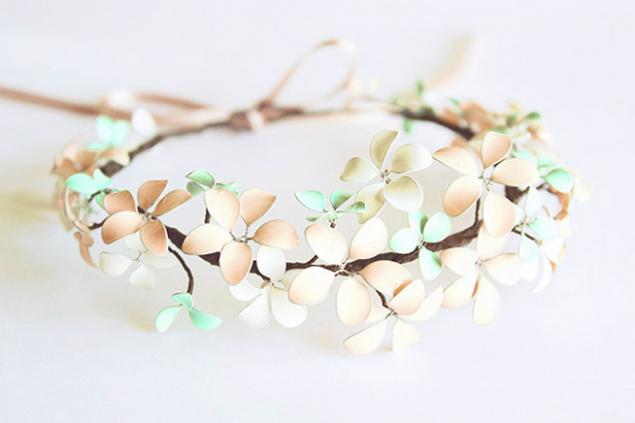
NB, as far as I can tell, this is the original web page plus it has instructions.  Downside is that it is a russian page, but thanks to the excellent pictures and google translate, is understandable.

I've a little project on the go that I thought might work with this technique but I faced a problem.  While fine wire is simple to get, I am not a big nail polish plan.  I only have five bottles of the stuff and only one of them is something in a 'flower/plant' shade.  Going out and buying some would get very expensive, very fast as well as being a waste.  So I started thinking, is there anything else out there that would work?

So what else is one to do but put some things to the test?  Going through my supplies I settled on a short list of the most likely alternatives.  In addition to some nail polish as a control, I used some paint on glass paint that I had left over from a kit; Mod Podge Dimensional Magic; Lisa Pavelka Magic-Glos, a resin that sets when exposed to UV light; PVA glue (aka white glue); and clear craft glue.  To test each one, I make equal sized loops using a Bic ballpoint pen, out of some fine wire (28 or 32 gauge I'm guessing as it was not labelled).


For all these materials, I have either painted using a brush or 'dipped' the loop into a small pool of the material in whatever method worked best to form a film in the wire loop.

Nail Polish

One layer of nail polish
Brushing this on directly didn't work, as I could not form a film without it popping.  However, dipping the loop carefully into a small puddle worked well.  The finished effect was a lovely transparent loop, like stained glass.  It was very thin however, and careful poking with a finger showed that it would not hold up to any wear.  When I tried to do a second layer, it seemed to 'melt' the already present layer.

Glass Paint

Glass paint when still wet
Initially this looked promising.  The paint went on beautifully using a paint brush and a nice thick layer formed.  However, while it also had a lovely translucent look, it also somehow dried with a small hole.


Once dry, one layer of the glass paint dried with a hole or crack
A second coat closed the hole and made a more uniform appearance but does make the loop more opaque.

Mod Podge Dimension Magic

This is another material I had to apply by dipping it into a small pool.  However, this was the easiest of all the materials that needed this method to do as it's slightly thicker consistency meant that the film formed first time.  One layer also appeared to be much more durable than nail polish, although if I was to use this for jewellery, I would plan on using a few more layers.  The layer was also very uniform in thickness so there are no 'blobs' left over.

The other great advantage of this material is that it is transparent.  Once it has set, a sharpie or similar would allow any colour (or design) to be applied.

When wet, Dimension Magic has a whitish appearance, but dries clear.

Lisa Pavelka Magic-Glos

I had the highest hopes for this stuff as I have played with it before and it makes a lovely solid layer when dry.  However, in the past I used it with wire shapes stuck temporarily to a sticky tape background while the gloss set.  When trying to use it directly, without a backing film, it was an unmitigated disaster.  Straight out of the bottle it is almost as viscous as water.  Every tried to dip a bubble wand in straight water?  Hard to make a film, isn't it?

Aha, I thought though.  I'll let it partly cure (it was morning so light was coming through the window enough to set it), then it will be thick and work well.


Yeah, not so much.

PVA glue

PVA can be very different in thicknesses depending on brand and age of the bottle.  My PVA was a little runny so it took several attempts to get it onto the loop.  Once there, it took a bit of careful rotation for a minute for it to dry enough without a thin spot that would turn into a hole.  

When dry, it was mostly clear but with a slight white fog to it.  Not a big deal if you want to colour it anyway but might be a factor if you want it to be perfectly transparent.

Craft glue

This glue was easy to put into the wire loop but it was very bubbly!  If working with some of these materials, a little blow torch is a good tool to pop bubbles (it also works with varnish).  However, DO NOT TRY THIS WITH THIS GLUE.  Fire will not pop the bubbles, it will happily set the whole thing on fire.  Yes I did test this under very carefully controlled conditions (aka, I didn't set the house on fire). Yes it did catch fire. This is generally not a good idea!  As I've never been able to use this glue without a few bubbles here and there, it's best to be used only if you want the bubbles as a feature.


Summary

Rating of different materials to fill in wire loops
Sorry the table is a bit dodgy- Blogger doesn't do tables so I had to improvise

Each category rated out of three.  +++ is the best, + the worst or - for things that didn't work.

What is the best product to use?  Well it will depend a lot on your budget, patience, and the final use of the loops or flowers you make.  For all materials, if you don't want to mess with a temporary backing material like tape, your loops need to be small.  Mine were about 1 cm in diameter and I feel it is about as big as can be managed.

If you had an addiction to nail polish already and so have many many bottles in a rainbow of colours, then go for it!  Modern nail polish reportedly was first derived from car body paints, so it is not terribly surprising that it's a fairly durable product.  The only possible catch is that you may need to buy colours that work for your project and you may find a limited selection of some shades- few people generally wear green or brown nail polish for instance.

If you are on a budget and don't already have nail polish then I would say PVA  glue is best, followed by Dimension Magic -about AUD$8 a bottle but that will go a long way with the amount needed.  Because these can be coloured with markers, it gives you the greatest range of colour flexibility.

If you are after durability, then I would suggest Magic-glos but with a proviso that this assumes you back every wire loop with tape until it sets. Multiple layers of nail polish and glass paint are also options, or Dimension Magic are also possible.  Craft glue also works, provided you are OK with the bubble factor.

And for the scientifically inclined, no, I didn't have replicates.  This was a small preliminary study and these results will be shown in a subsequent report... (or, comment or otherwise leave some feedback to encourage me and I might go and do some more testing!).  

What will I use?  Stay tuned for a future post to find out!
Plus I have not decided yet

Click here to see one use I put these too to make flower vines.

Friday, 17 January 2014

Sugar geodes

What does it take for me to post again?  Being trapped inside after the 4th day of 40+ C temperatures!   Hello everyone, hope you are surviving the incredible heat or incredible cold depending on what part of the world you are in.

Today's post is thanks to an activity I did with my students in Science Club (a lunchtime activity for students between Grade 5 and Year 8).  We did this over two weeks to great acclaim from the students.  This tutorial was written for someone doing this in their kitchen (since I this as a test run at home) but if you are a teacher and would like any advice for trying this in a classroom setting, let me know in the comments.

The goal is to make sugar geodes.  This basically uses the same sort of process that makes any crystal you might find in the ground, the only difference being the materials are edible and the process is nice and fast compared to typical geological processes!

Materials needed

  • Sugar
  • Water
  • Food dye
  • Flavouring (I used vanilla essence and peppermint essence but that's only because that's all I had in the pantry!)
  • Aluminium foil
  • Small bowls or similar (I used a muffin tray)
  • Measuring cups
  • Small saucepan and wooden spoon
  • Stove

Method

First take the aluminium foil and fit it into your bowl.  Geodes are not typically a perfect symmetrical shape so feel free to scrunch it into a bowlish shape that pleases you.  Add a drop or two of food dye and ONE drop of flavouring.  

Now to make the sugar solution.  The exact amount is up to you.  The important thing is that you use a ratio of three parts sugar to one part water.  I used 3/4 cups of sugar to 1/4 cups of water to make four small geodes but it is entirely up to you!

Place this over a low heat on the stove and stir continuously (this is the part where careful adult supervision is a must if you are doing this with kids).  Initially it will be a whiteish sludge due to most of the sugar not dissolving.
But this is where the magic of science happens.  Why?

SCIENCE DIGRESSION SCIENCE DIGRESSION SCIENCE DIGRESSION
Well when a solid like sugar dissolves in water, what happens is that each individual sugar molecule gets surrounded by water and escorted away to do a tour of the container.  Alright, the last bit I made up but the point remains.  As long as there are water molecules looking for a friend, the solid will continue to dissolve over time.  But the water is moving at a certain speed (because it is 20°C) and eventually all the water molecules are busy escorting the dissolved sugar around and if there is any more solid sugar present it will sit at the bottom of the container.  In science, this is called a saturated solution.
But if we heat the water, those water molecules are moving faster.  This means they can now deal with more sugar molecules and so it can now dissolve that abandoned sugar at the bottom.  We call this a supersaturated solution.  When we cool this solution it is like a person holding a very very large and precariously balanced set of fragile materials.  There is really not enough room for those sugar molecules now so all it takes is a tiny bit of undissolved crystal or a flaw in the container to act as a nucleation site (place were a crystal can start to grow).

END SCIENCE DIGRESSION END SCIENCE DIGRESSION END SCIENCE DIGRESSION 

Carefully keep stirring your mix until the mixture is clear.
Then carefully pour this mixture (while still hot!) into your prepared containers.
It will take several days for the crystals to grow but you will probably see them start to appear in 5-10 minutes as the mixture cools.
Three days later...
I found that I had a 'liquid centre' with crystals on the surface of the liquid as well as lining your foil.  The easiest way to deal with this is to gently press in the top middle of your crystal to make a hole and then leave the geode upside down over a bowl to drain.  It's best to leave it for a few hours at least to dry as if the sugar crystals are still damp you may find them breaking slightly when you peel the foil away.  If they feel a little damp, leave them in a cool dry place for a while.
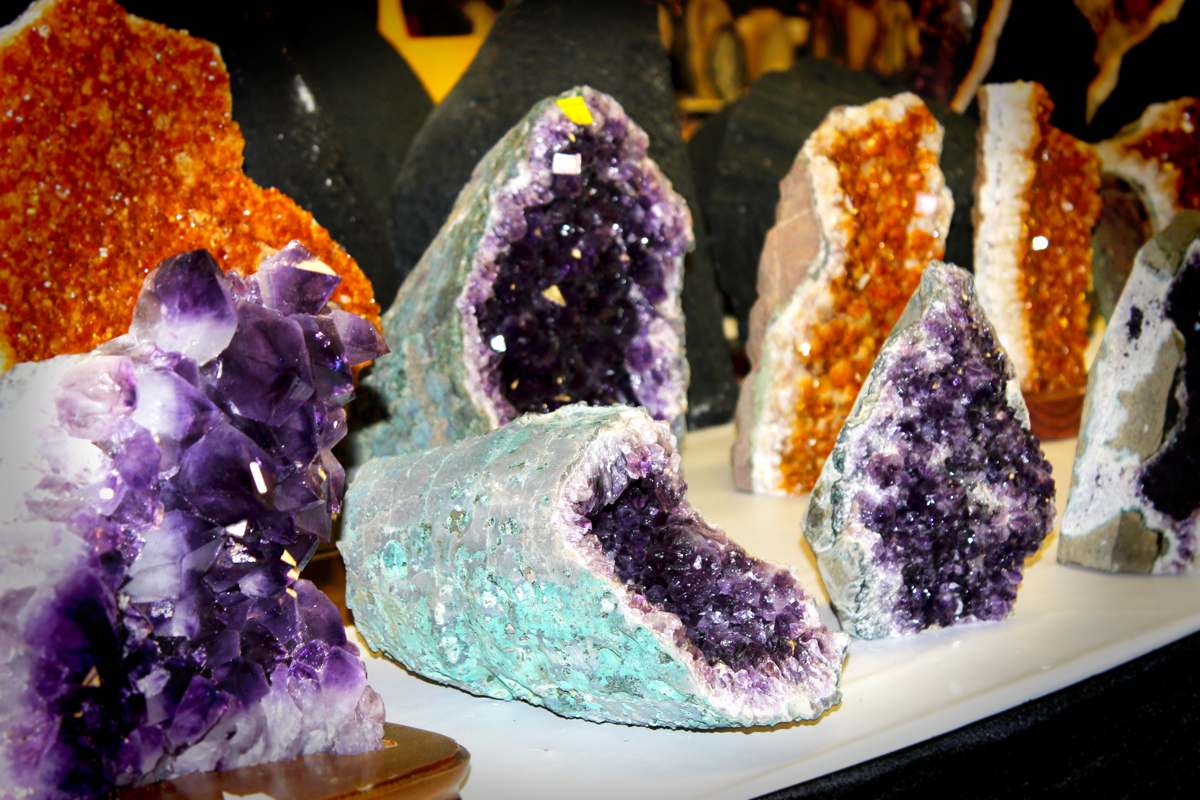
Now for the fun part- adding the matrix.  No not the movie. The matrix is the geology term for the rock that we find crystals in.  For example, in the picture on the left you can see some rather pretty samples of amethyst.  These are from round geodes (the green rock) that have been broken open to reveal the pretty purple amethyst inside.  Since the goal is to keep things edible, we can't use rock so instead there are two choices.  I've seen some instructions that suggested using fondant.  But I went with chocolate, because... hello... chocolate!!!!

Ahem.  Adding chocolate is simple.  Just melt some white chocolate and spoon it over your geodes.  Place in the fridge to set the chocolate.
Then, add some milk or dark on top so you get that multiple layer feel you often see with crystals like amethyst. 
And that's it!  Because the crystals are lots of individual units in this method, I found that they were crunchy but not one solid block of tooth breaking terror (but be careful on that first bite- your results may vary!).  Very very sweet- not really my favourite but very popular with my Science Club kids!

Friday, 19 August 2011

Make some DNA earrings

Yet another busy week of assignments but I have a new project to post!  Mainly because it's a two for the price of one- it's modidfied from an assignment/ student worksheet that I am making.  Today's project is to make a pair of DNA earrings (or a DNA key chain or window dangle etc).  But first, allow the science geek in me to give you a quick run through on the wonders of deoxyribonucleic acid, better known as DNA (because saying deoxyribonucleic acid too fast is likely to cause tongue dislocations in non-professionals like myself).

DNA is the 'building block of life'.  Nearly every cell in our bodies contains a nucleus- while everyone knows red blood cells don't have nuclei, (plural of nucleus), did you know that mature lens fiber cells in your eye also don't have nuclei?  I didn't before writing this.  Back in the distant past when your parents were doing things you don't want to think about, each parent contributed half of their genetic material to form you.  The exact nature of which I won't go into here- if you are interested in how a cell divides to sort a full human's complement of DNA into half a complement, then go read up on meiosis.  And if you want to read about how those two halves of DNA meet, then there are large portions of the internet dedicated to that sort of thing, so I won't go into it here!

Inside your nuclei you have 23 pairs of chromosomes- 22 autosomes and two sex chromosomes (XX if you are a girl, XY if you are a boy generally).  Each chromosome is made up of a really, really, really, really tightly wrapped length of a single piece of DNA.  The picture below (that I got from this website that goes into a bit more detail than I will here if you are interested in reading more) isn't too bad at showing how it works.  A single piece of DNA (that looks like a twisted ladder), the strand is wrapped around proteins called histones.  These histones are then twisted in turn to form a slightly thicker rope of DNA which is then wrapped further until you end up with a chromosome.


DNA is a polymer, which is a fancy way of saying it is made up of lots of individual units joined together.
These individual units are called nucleotides.  Each nucleotide is made of three parts, a sugar (called deoxyribose), a phosphate group and a nitrogen base.  The nucleotides join together with the sugar group of one joining to the phosphate group of another and so on.  These are the two handrails of the DNA ladder, or more commonly referred to as the sugar phosphate backbone.  A DNA molecule is made of two strands of nuclotide polymers that are joined in the middle at the nitrogen bases- the rungs of the ladder.

There are four different nucleotides found in DNA and these four nucleotides are common to all known life on earth: adenine, guanine, thymine and cytosine.  Adenine and thymine will always pair together in a DNA molecule and guanine and cytosine will always pair together.  The jury is out as to whether E.T. will have the same bases or not- it largely depends on if you believe that the system developed here on earth, which would mean that E.T. would probably have a totally different system, or if life actually came to earth from elsewhere in the universe on an asteroid or comet, in which case who knows.  Or it depends on what sort of Sci-fi you like to read or watch- Star Trek yes, something else possibly not!

OK, that's enough of me boring you for now, lets get on with making our pretty shiny things.  First off the material list.  You will need:
  • Some fine wire (28 or 32 gauge (I have 26 in the photo but it ended up being too thick- I ended up using 32 for mine)
  • Seed beads (two colours, two of each colour for every rung of the DNA)
  • Bugle beads (four colours- one for each nitrogen base.  Remember, to be accurate your adenine and thymine will always pair together and your guanine and cytosine will always pair together so bear that in mind with your colour choices)
  • Wire cutters (or trashed scissors)
  • Earring hooks or keychain hooks or fishing line depending on the final function)
  • A toothpick or a paper clip
STEP 1
Work out how many beads you will need of each colour and type to make a DNA molecule.  The instructions below are for a piece 12 nucleotides long which will produce a nice twist.  Use a longer wire and more beads if you want to make something longer.  You will also need a 90 cm length of fine wire.
Sugar
Phosphate
Nitrogen bases     - adenine
    - guanine
    - thymine
    - cytosine

STEP 1
Take a 90 cm length of wire and find the middle point.  Thread onto the wire two bases (long skinny beads), a sugar and a phosphate and move them to the middle of the wire.


STEP2
Now add a sugar and the next base onto each end of the wire.


STEP 3
Thread each end of the wire into the base and sugar (in order) on the other side of the molecule to form a circle.  Gently pull on each end of the wire until the beads are snuggly against each other.

STEP 4
Add a phosphate, a sugar and the next base pair to both ends of the wire.

STEP 5
Thread the ends of the wires through the base and the sugar on the opposite strand as you did in step 3.  Gently pull on wires until beads are snuggly against each other.

STEP 6
Repeat step 4 and 5 until your DNA ladder is 12 bases long.  On the last base leave a gap in the wires between the two nucleotide bases. 

STEP 7
Use something thin like a toothpick, straightened paperclip or the tip of a pencil to twist the wire around twice.  This makes a loop that you can hang an earring hook or a keychain loop on.

STEP 8
Take the ends of the wires and thread them down through the phosphate beads to the bottom.  This strengthens your DNA molecule. 

STEP 9
Trim the ends of the wire close to your DNA ladder.


STEP 9
Give your DNA molecule a gentle anticlockwise twist and attach an earring hook, key chain ring or tie it to some fishing line if you wish.

Isn't that sweet?  These instructions are rewritten from here.  I'll spare you the educational questions I'll adding to my assignment!  But fun factoid- human chromosomes are from about 50 Mbp (that's 50,000,000 base pairs) to 250 Mbp in length.  The molecule above is 12 base pairs long.  I'll let you figure out how long and how many beads you'd need to make one of these babies to scale!

Tuesday, 28 June 2011

Acid free paper- why? And what is lignin anyway?

Whether you are a die hard scrapbooker or a collector of something (for example, Discworld stamps), you have probably encountered the term ‘acid free’ or ‘lignin free’ paper.  These tell the user that the paper is suitable for long term use.  But what do they mean?

For that we need to take a big step backwards to look at the history of paper itself.  Papermaking has been around for a long time- in a 2006 World Archaeological report fragments of linen paper from China dating back to 8 BCE have been reported.  While paper can be made from a wide range of materials including mulberry, flax and hemp, both directly from plants and from old worn out materials like rope, rags and hemp waste, most paper commercially made today is made from wood pulp.

We can use these materials, including wood, due to the nature of the plant material.  Plant cells are surrounded by a special structure called a cell wall.  The cell wall is a strong, flexible structure that helps plants to keep their shape- whether that means a leaf of 5-6 cells thick or a massive eucalypt tree trunk that must support the weight of the branches above.  It does this by stopping cells from expanding too much under water pressure.   Think of a cell like a balloon.  If you keep adding water, it will continue to expand.  However, the cell wall acts like a flexible but non-expanding sock around that balloon- like a fabric bag around the balloon.  While the balloon is smaller than the tube, it can expand.  But once it has expanded to touch the fabric material, it must hold it’s shape.  It can’t expand out because the fabric will not stretch.  If you made the fabric bag long and skinny, the balloon could stretch to a long and skinny shape- and if the pressure of the water is enough, then it will hold that shape and be able to support itself.  Conversely, if you take the water away it will droop- just like plants can droop if they don’t have enough water.

Cell walls are made of lots of different polymers and other compounds in several separate layers.  The main component is cellulose (35-50%) which is made of thousands and thousands of glucose molecules linked together to make a long chain.  This is the stuff that we are interested in to make paper.  The long chains of cellulouse from wood (or the plant material of choice) are processed form fibres suspended in liquid.  These fibres are then passed through a fine screen so that the water drains away, leaving a thin layer of randomly tangled mat of fibres.  When this dries, we have our piece of paper.

But cellulose is not the only component of cell walls.  One of the other major components is lignin.  Lignin is a complex polymer (for just how complex, see the Wikipedia entry for it) that makes up 10-25% of the cell wall.  In the plant it acts to strengthen the cell wall.  But if left in paper it will break down over time.  Newsprint has most of the lignin still in it.  Over time lignin will react with oxygen in the air and form a yellow colour- this is why newspapers yellow over time and why those making scrapbook paper art don’t want lignin in their papers.

Paper can be chemically treated in the production process to remove most of the lignin but the process is acidic.  The downside of this process is that the paper produced is acidic (pH less than 7).  Over time the acid reacts with the cellulose and degrades it- breaks it down.  This is a bad thing if you want to store information in a book, wrap up a precious object in tissue paper (as the acid will also act on the object, particularly if it is a natural material like cotton or linen), or have something precious in contact with it, like stamps in an album.

So to sum up.  If you are making a book, scrapbooking old family photos, storing your stamps or wrapping up your baby’s first outfit to save for your grandchildren, you might want to consider the paper you are using.  Acid free means that the paper will not degrade over time, nor will it damage anything it is in contact with over time.  Lignin free means that it will not yellow over time.  If you have some paper that you don’t know is acid free or not, pH pens exist that you can test your object with.  These are textas (or markers) that change colour based on the pH of the paper.  Just put a dot on an unobtrusive section and compare the colour to the chart that will come with the pen.  If you have something that is acidic that you want to preserve, there are pH neutralisers available in spray cans that should work on all papers (your results may vary, etc etc).

And if you just want to print out an assignment for uni, don’t worry about it.  No one will, including you, will ever want to look at that piece of paper again so just use whatever is cheap and handy and don’t forget to recycle it after!