Showing posts with label Jewellery. Show all posts

Sunday, 10 August 2014

A few bits and bots

I've finished the crochet bag!  Horray!  The final bit joining the flowers to form a base was fiddly, but it turns out if you go back and read the instructions rather than making things up works well *sigh*  And of course, by finished, I mean 'up to the point where I have to sew a lining, attach to the crochet, work out a suitable handle and source all materials needed to do these things.

But I hated the baby blue thread.  Sadly, there wasn't a lot of choice when buying the thread since it was that, pink (double blech), cream or white.  So I've pulled out the dye stocks and had a go.

Here's before, in the original, baby blue thread.
And here is after I tried dying it in a mix of turquoise (blue), periwinkle (purple) and a hint of black.  The end result is a darkish, forget-me-not blue.

I have not decided what I'm going to line it with.  At the moment  I quite like the cream- a bit of spare calico- that I've used to show the pattern a bit clearer, but I'll have a think about it.

Finally, here's some jewellery that I've made.  The earrings because I found the kit when sorting out my beading stuff, and the bracelet that was something I had put into my beading stuff to be fixed and never got around to.

And this post is the last of my holiday posts.  It's closing to the end of the third week of school and sadly the large pile of marking, planning etc has sucked up all my time (free or otherwise!).  So expect irregular posts for a few months.

Sunday, 27 April 2014

Making flower vines

I was going to have this as part of another post but decided this is better as a stand alone tutorial as there are many potential uses for this technique.  The next post will show you how I used the flower vine I made here.

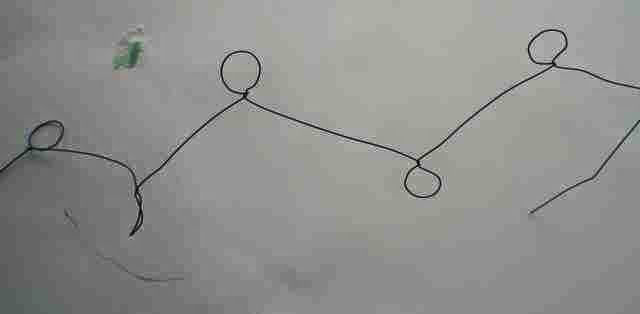
To make the vine, estimate how long you want your vine to be.  The main wire should be about 2.5X this length.  I went with about 50 cm long.  Using something about the right width (a pen or pencil are ideal), create a series of loops roughly evenly spaced along the wire.


Each of these loops will become leaves, so now shape them as you wish.  The easiest way to get a leaf shape is to gently pinch the top.  Of course if you are a botanist, feel free to go and google the species you wish to mimic and shape your leaves accordingly.

Now use your medium of choice to fill in the shapes.  I went with Mod Podge Dimension Magic but in this post I investigate several different materials you can use.

Let this dry and (if you used a transparent filler as I did) use a permament to colour in the leaves.  The layer may be very thin- be careful not to make holes, but if you do (or if you feel it is too thin anyway), add another layer of medium.


Flowers are made in a similar way to leaves.  It is best to make each flower from a separate piece of wire (about 20 cm is a good length).  I used a slightly smaller diameter stick to make four loops very close to each other for the petals and sometimes also added a leaf or two to the remaining length


Now to put it all together.  Take the main length of leaves and double them over.  Start at the bottom and gently twist them together.  At intervals, add the flower wires and incorporate them into the main stem as you twist.

Continue the length of the main wire.

You can trim any stray bits of wire if you wish.  You may also want to wrap florist tape around the 'stem' to hide the wires and make it a bit more natural looking.  This is also a good idea if you plan on using this length of wire as jewellery or a hair decoration as those little ends of wire may try to poke the wearer otherwise!

I love the transparent effect you get using permanent markers.  The depth of colour can be increased by using multiple layers of your clear filling material (a good idea for strength anyway) and colouring each layer as you go.  Or get fancy with a fine tipped pen for further detail, similar to the painting on stained glass windows in old churches.


Somewhere in the distant future I plan on playing with this more to make some jewellery but if you beat me to the punch, I'd love to see!  Leave a comment or shoot me an email.

Sunday, 13 April 2014

Nail Polish flowers- technique and material testing

Every now and then I like to take a browse through Pintrest.  I find that it can be interesting to find ideas, but the big downside is that you see a lot of things repeatedly, find things listed in the wrong category (cooking recipies do NOT belong in the DIY and Craft category!) or are things that you could not pay me to would have to pay me a great deal of money to do and even more money to have me keep it in my house!

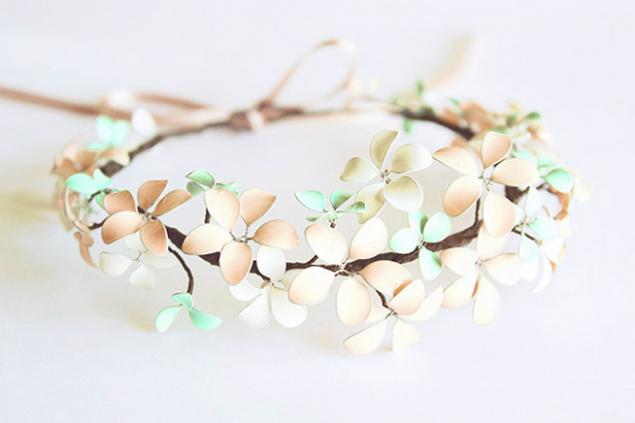
But some things are truely lovely and I do end up pinning them to my own boards.  One that has been regularly on my list of things to try is this lovely nail polish flower bracelet/necklace?

NB, as far as I can tell, this is the original web page plus it has instructions.  Downside is that it is a russian page, but thanks to the excellent pictures and google translate, is understandable.

I've a little project on the go that I thought might work with this technique but I faced a problem.  While fine wire is simple to get, I am not a big nail polish plan.  I only have five bottles of the stuff and only one of them is something in a 'flower/plant' shade.  Going out and buying some would get very expensive, very fast as well as being a waste.  So I started thinking, is there anything else out there that would work?

So what else is one to do but put some things to the test?  Going through my supplies I settled on a short list of the most likely alternatives.  In addition to some nail polish as a control, I used some paint on glass paint that I had left over from a kit; Mod Podge Dimensional Magic; Lisa Pavelka Magic-Glos, a resin that sets when exposed to UV light; PVA glue (aka white glue); and clear craft glue.  To test each one, I make equal sized loops using a Bic ballpoint pen, out of some fine wire (28 or 32 gauge I'm guessing as it was not labelled).


For all these materials, I have either painted using a brush or 'dipped' the loop into a small pool of the material in whatever method worked best to form a film in the wire loop.

Nail Polish

One layer of nail polish
Brushing this on directly didn't work, as I could not form a film without it popping.  However, dipping the loop carefully into a small puddle worked well.  The finished effect was a lovely transparent loop, like stained glass.  It was very thin however, and careful poking with a finger showed that it would not hold up to any wear.  When I tried to do a second layer, it seemed to 'melt' the already present layer.

Glass Paint

Glass paint when still wet
Initially this looked promising.  The paint went on beautifully using a paint brush and a nice thick layer formed.  However, while it also had a lovely translucent look, it also somehow dried with a small hole.


Once dry, one layer of the glass paint dried with a hole or crack
A second coat closed the hole and made a more uniform appearance but does make the loop more opaque.

Mod Podge Dimension Magic

This is another material I had to apply by dipping it into a small pool.  However, this was the easiest of all the materials that needed this method to do as it's slightly thicker consistency meant that the film formed first time.  One layer also appeared to be much more durable than nail polish, although if I was to use this for jewellery, I would plan on using a few more layers.  The layer was also very uniform in thickness so there are no 'blobs' left over.

The other great advantage of this material is that it is transparent.  Once it has set, a sharpie or similar would allow any colour (or design) to be applied.

When wet, Dimension Magic has a whitish appearance, but dries clear.

Lisa Pavelka Magic-Glos

I had the highest hopes for this stuff as I have played with it before and it makes a lovely solid layer when dry.  However, in the past I used it with wire shapes stuck temporarily to a sticky tape background while the gloss set.  When trying to use it directly, without a backing film, it was an unmitigated disaster.  Straight out of the bottle it is almost as viscous as water.  Every tried to dip a bubble wand in straight water?  Hard to make a film, isn't it?

Aha, I thought though.  I'll let it partly cure (it was morning so light was coming through the window enough to set it), then it will be thick and work well.


Yeah, not so much.

PVA glue

PVA can be very different in thicknesses depending on brand and age of the bottle.  My PVA was a little runny so it took several attempts to get it onto the loop.  Once there, it took a bit of careful rotation for a minute for it to dry enough without a thin spot that would turn into a hole.  

When dry, it was mostly clear but with a slight white fog to it.  Not a big deal if you want to colour it anyway but might be a factor if you want it to be perfectly transparent.

Craft glue

This glue was easy to put into the wire loop but it was very bubbly!  If working with some of these materials, a little blow torch is a good tool to pop bubbles (it also works with varnish).  However, DO NOT TRY THIS WITH THIS GLUE.  Fire will not pop the bubbles, it will happily set the whole thing on fire.  Yes I did test this under very carefully controlled conditions (aka, I didn't set the house on fire). Yes it did catch fire. This is generally not a good idea!  As I've never been able to use this glue without a few bubbles here and there, it's best to be used only if you want the bubbles as a feature.


Summary

Rating of different materials to fill in wire loops
Sorry the table is a bit dodgy- Blogger doesn't do tables so I had to improvise

Each category rated out of three.  +++ is the best, + the worst or - for things that didn't work.

What is the best product to use?  Well it will depend a lot on your budget, patience, and the final use of the loops or flowers you make.  For all materials, if you don't want to mess with a temporary backing material like tape, your loops need to be small.  Mine were about 1 cm in diameter and I feel it is about as big as can be managed.

If you had an addiction to nail polish already and so have many many bottles in a rainbow of colours, then go for it!  Modern nail polish reportedly was first derived from car body paints, so it is not terribly surprising that it's a fairly durable product.  The only possible catch is that you may need to buy colours that work for your project and you may find a limited selection of some shades- few people generally wear green or brown nail polish for instance.

If you are on a budget and don't already have nail polish then I would say PVA  glue is best, followed by Dimension Magic -about AUD$8 a bottle but that will go a long way with the amount needed.  Because these can be coloured with markers, it gives you the greatest range of colour flexibility.

If you are after durability, then I would suggest Magic-glos but with a proviso that this assumes you back every wire loop with tape until it sets. Multiple layers of nail polish and glass paint are also options, or Dimension Magic are also possible.  Craft glue also works, provided you are OK with the bubble factor.

And for the scientifically inclined, no, I didn't have replicates.  This was a small preliminary study and these results will be shown in a subsequent report... (or, comment or otherwise leave some feedback to encourage me and I might go and do some more testing!).  

What will I use?  Stay tuned for a future post to find out!
Plus I have not decided yet

Click here to see one use I put these too to make flower vines.

Monday, 1 July 2013

Little things during the holidays

Some of these have not been worth a full post so here's a round-up of the crafty things I've done over the last few months.

First some polymer clay toadstools.  This was a Pinterest inspiration and looked simple enough that my basic skills could manage.  Only suggestion I'd make if you wanted to DIY is to make the stalks around a toothpick or skewer to make it a bit easier to stick them into the pot.  This would not be as vital if they didn't apparently scream 'attack me!' to my neighbours cat who has shuffled them around and played with them as soon as I added them.  All I can say is that it's a good thing my neighbour's cat is cute and friendly!

Next is a pretty silver bracelet I got the kit for from the last Melbourne Craft Fair.  I love the three dimensional nature of it!

This little bag was another kit- it has a cool little pinch to open bendy clasp and the bag fabric is pretty (another Craft Fair purchase- the website for the shop is here).


And since one of my unfinished holiday projects was this post, here's another from these holidays.

It is a secret compartment keyring by Silkstone Designs.  It's yet another kit project that I bought on the last holiday that was on (camping down at Inverloch).  Doesn't everyone buy craft stuff as souvenirs?  Not that it was all smooth sailing on this one.  Can you spot the mistake in the example below?
I'd plug this one but the website listed on the back of the instructions is dead and I couldn't find any online.  The only thing I can suggest is that if you are in the area, swing by Coal Creek Historic Park and check out the obligatory little shop.  If you are in the area you should swing by anyway- I like old parks like that :D

Oh, and as always, I don't get kickbacks from anyone.  If I've linked to something it's because I bought it and liked it.  Not that I would be against plugging something for a fee- it's just the opportunity has never come up! Now it's back to the pile of half done stuff...


Sunday, 2 October 2011

Finished stuff- September doings

I've finished a few things recently that I want to show off, but since I bought them as kits I can only provide links, not instructions.  Still, it's nice to have a wrap up of the end of the month craft doings.  Sorry for those for those looking for projects.  But they are really awesome kits so if you do like them, feel free to go and by one.

First of all is this lovely bracelet I bought, a Chainmaille crystal weave bracelet.  Little fiddly to get the hang of the maille technique but once you do the results are great.  I think the bracelet looks a little bit like a honey bee- I'm tempted to get some small black links and try modifying the pattern to make a honey bee bracelet.  If I do, I'll post some instructions.

Next is a part of a birthday present for my niece who will be turning 3 next week.  It was going to be something she could play with a bit but it turned out to be just too impractical for that.  The small pots and such are too unbalanced so had to be glued down.  But it's pretty and I know her Mum already made a few for the wall of her room because we bought the kits at the same time for... wait for it... $5 each!  Bargain or what!  No online link for it, but if you are in Melbourne then Theo's Discount Craft in Boronia (outer eastern suburbs) is well worth a visit.  They have lots of import stuff, mainly jewellery findings and sewing stuff but also a random mix of other stuff too.

Next, I didn't make these but my Mum is an awesome card maker and my go-to stop for card supplies.  I need a few thank-you cards I need to give in a few weeks to my awesome teaching placement mentor teachers (I have to go back to finish my time at the end of the month).  She made these this week and they were so pretty and suitable I nicked them on the spot:

And now to wrap this post up, here's my procrastinating owls in progress.  I've done the body and one sleeve up to the armpits so I'm just about to cast on for the second sleeve.  And in terms of assignments I now only have one large evil one left (total blank so I guess I'll start it next week) and a few smaller pieces that I'll get around to eventually :P

Sunday, 11 September 2011

Mounting miniature embroidery

Another post in the Rose Broach saga...

The story so far.  Several weeks ago I bought a pretty little broach from a market of unknown age.  However it had unfortunate ugly staining on the side, probably old glue going icky.  When cleaning proved unsuccessful I pulled it apart to see if more drastic action would improve things.  With the embroidery removed from it's mounting I could also see what the original pattern colours looked like so made two cross stitch chart variants which you can find here. In this episode, I take the original embroidery and give it a new life...

Here's what I had at the start of today's post- the embroidery that I had cut from the mount and lightly trimmed the worst of the discolouration off. But I could not remount it in the original broach due to the size of the work now being much smaller- there needs to be enough fabric in the mount above to fit around the front of the mount (the domed round metal piece) with edges long enough to be able to tuck underneath and be held by the backing plate.

Solution?  I popped out to my local sewing supply shop and I bought some self covering fabric buttons.  These come in a range of sizes but for this work I used the 28 mm diameter button.  You can see that the materials for these have not exactly changed a lot.  Aside from size the domed pieces look near identical.  Only the backs are different materials.  The red and the yellow things are to help you mount your fabric in place- you'll see more on this later.


Because I wanted to have the embroidery centred on the button I first stitched a running stitch around the edge.  This meant that I could check the pattern was where I wanted it to be as you can see below.


Then it was into the handy red thing designed to hold everything in place (after making this button all I can say is DON'T LOOSE THIS or the rest of your button blanks (they come in a pack of 5) will be next to useless.  The red thing is made of a soft rubber that holds the material snuggly.
Those gathering stitches were handy though as they helped pull the material in from the edge.  I would suggest you do the same even if you have more edge material than I do.

Next step is adding the back- the yellow thing is the handy back holder that lets you press evenly to push the plastic back into the metal front, hopefully catching all the edges of the fabric at the same time.


Back view- sorry about the thread.  I was about to go to the next step before I remembered I hadn't taken photos yet!
Now this could be the finish point if you wish- all I did above was cut the shank of the button off with a craft knife so there would be room to glue a broach pin on.  This step is best done before you start but since I didn't think of it I just improvised and tried not to cut the material.  But the pin looks a little plain...
Front view
My solution?  I stitched seed beads around the edge of the button to frame it.  The great advantage of this method is that you don't have to try and find something the right shape and you can use whatever colours you like!  I choose a silver and black alternative frame as it reminded me of the original old silver backing, but this could look lovely if you picked colours from the roses or leaves or perhaps used pearl coloured beads.  The choice is yours.

Overall verdict?  Well it isn't perfect.  The design goes over the edges a bit so it doesn't have the white border to edge it to really make it pop the way the original had.  However, now you can't see yuck staining either.  The seed beads will also hopefully protect the edges of the pin from wear.  Since the edges are where the fabric will first rip and wear away due to rubbing it will give the embroidery a much longer life (the original pin had places where the fabric beginning to fray in addition to the staining).  And the backing piece will be used as soon as I can decide on what to stitch for it (hmm, same pattern or something else?)   Let's call it a good B+ which can become an A when I utilise the original broach backing.

What do you think?  Find these instructions useful?  Drop me a comment or an email- I would be THRILLED to know others are reading this blog and using the material!

Friday, 9 September 2011

Rose brooch cross stitch pattern

The original piece
Remember that old broach that I pulled apart?  Well I decided that it would be nice to have the pattern in case I damaged the original in my cleaning and deconstruction.  It turned out to be easier said than done- even blowing up the photo it was hard to see the stitching to reverse construct the process.  I also had the drama of finding some software to make the pattern in.  I used to have a copy of  PCStitch but lost the CD in a move.  Since this was for a small, one-off project I did not want to fork out lots of money on another copy so went on the prowl for something else to use.  I made the charts below using KG-Chart for Cross Stitch- they have a light version that is free that lets you create small patterns (for large you need to pay).  Overall I was fairly happy- the only downside was I couldn't seem to easily make a contained digital chart to post with both the symbols/chart AND the colour key.  I ended up having to do a screenshot to make the patterns below.  The screen colours also don't seem quite right for the DMC colours.  You can compare the lighter green colour in the leaves of the broach above and the pattern below to see what I mean- while the threads are a near perfect match, the computer pattern seemed to be a much darker colour.  But that said, the software did the job and was fairly simple to use.

So enough about the process, here's the pattern for you to enjoy.  It is not a perfect copy of the original as the small size and slight variation in colour fading means that it is more of a 'inspired by' pattern.  It also has not been test stitched yet since I'm still doing teaching rounds right now.   However, the colours (I used DMC embroidery floss colours) are as close a match as I can make them.  Click on the pattern below to see the full size version.


But wait!  Those who read my last post will remember that when I pulled it apart we got a glimpse of the original colours when looking at the back.  And as a comparison, here is the same pattern but this time I've matched to the back of the work- the side unaffected by light and wear over goodness knows how long.  Again DMC colours were used.

Much brighter, isn't it?  I also had to add an extra colour because, while the dark colour in the red and orange rose looked the same from the front, they appeared to be different shades from the back.  The green leaves are also noticeable as the lighter shade appeared yellow from the front but was originally a light green.

Now my great decision is what to do with the backing plate- stitch up the pattern above or something different?  And do I use the bright original colours or the muted colours for that vintage feel! Have an opinion?  Drop me a comment below.  I don't do decisions well and can use all the help I can get!

Sunday, 4 September 2011

Deconstructing a miniature embroidered broach

Several weeks ago I fell in love with a lovely old broach at a market stall at uni.  So despite the fact that the last thing I should be doing is buying things, it somehow managed to follow me home!  But it had a flaw that irritated me- there was a nasty stain around the edge. It's most noticable near the pink rose but there were a few marks elsewhere.  Close examination showed that it was due to a nasty seeping glue that had discoloured over time.
The broach after I attempted to clean it.  It is about 3 cm in diameter if you are curious.

When I got it home, I tried a few remedies to try and fix it- a gentle wash in warm water with a bit of detergent but no joy.  I then tried getting out the big guns- polar solvents.  This was a big risk- if the colours in the embroidery were not colourfast then I might find them bleeding everywhere and ruining the piece.

While the thread colours happily did not bleed, the stain did not move either.  I suppose I could've left as it was but I decided to take drastic action.  If you have a mint condition broach, I don't recommend the following- this one had already been repaired (the pin on the back was a modern one glued on to replace the original) and had the stain.  But be aware, if you have something with true value DON'T do the following!  I am not an expert- lovers of old things who spend weeks lovingly restoring things would probably be horrified.  I tried to treat the broach with respect but old glues meant that there was a certain lack of finesse in the following.

I decided to see if I could deconstruct the broach to either fix the embroidery if possible, or replace it with something I made myself.  Step one was to pry the backing place (flat metal with the decorative border) off the piece the embroidery was mounted on.  This had been glued down so a certain amount of prying was required.  They came apart fairly easily- the broach pin fell off due to a small amount of flexing, but since this had been glued on much more recently than the rest of the piece I just kept both to glue together again later.

The embroidery was mounted in a metal piece- it's hard to explain well.  The easiest thing is to probably look at the picture below.  An attempt to pry it apart was not successful as it was clear it was going to damage the embroidery so I resorted to using a knife to carefully cut around the fabric.  While this would mean the piece couldn't be remounted in the same broach, I felt it would ultimately cause less damage since it put less stress on the fabric.  Then I could finally separate the broach back- you can see the small dent in back piece.

A part of me wanted to find a signature or a scrap of paper in the back piece. It's a perfect little hollow space that would be awesome to put some tiny message into the future in that may or may not ever be seen again.  Now whether it should've been a posterity message 'this broach made in [insert date here] by me' or something to mess with future person's head 'Now look what you've done!' I'll leave as an interesting thought exercise to the reader.  Sadly there was no identifying marks, either paper or stitched into the border so the creator's identity will forever be a mystery.
Now while this has probably horrified any antique restorer, it has provided a great glimpse into how the piece was made in the first place.  The embroidery was stitched on a piece of off-white silky fabric with a even mesh light chiffon like fabric on top to provide the grid to stitch too.  It also provides a unique chance to see what the original colours are- I was very surprised to see the difference!

Here's what I mean.  Here is a photo of the front of the stitching on a black background.  To provide a colour comparison, I've included three DMC embroidery flosses: 334, 347 and 725 respectively.
And here is the back with the same DMC colours for comparison.
Much brighter, isn't it!  That's the colour that the original embroiderer intended- something bright and cheerful.  As for what I am going to do with a small piece of embroidery and an empty broach, well that's for future blog posts to tell...

Friday, 19 August 2011

Make some DNA earrings

Yet another busy week of assignments but I have a new project to post!  Mainly because it's a two for the price of one- it's modidfied from an assignment/ student worksheet that I am making.  Today's project is to make a pair of DNA earrings (or a DNA key chain or window dangle etc).  But first, allow the science geek in me to give you a quick run through on the wonders of deoxyribonucleic acid, better known as DNA (because saying deoxyribonucleic acid too fast is likely to cause tongue dislocations in non-professionals like myself).

DNA is the 'building block of life'.  Nearly every cell in our bodies contains a nucleus- while everyone knows red blood cells don't have nuclei, (plural of nucleus), did you know that mature lens fiber cells in your eye also don't have nuclei?  I didn't before writing this.  Back in the distant past when your parents were doing things you don't want to think about, each parent contributed half of their genetic material to form you.  The exact nature of which I won't go into here- if you are interested in how a cell divides to sort a full human's complement of DNA into half a complement, then go read up on meiosis.  And if you want to read about how those two halves of DNA meet, then there are large portions of the internet dedicated to that sort of thing, so I won't go into it here!

Inside your nuclei you have 23 pairs of chromosomes- 22 autosomes and two sex chromosomes (XX if you are a girl, XY if you are a boy generally).  Each chromosome is made up of a really, really, really, really tightly wrapped length of a single piece of DNA.  The picture below (that I got from this website that goes into a bit more detail than I will here if you are interested in reading more) isn't too bad at showing how it works.  A single piece of DNA (that looks like a twisted ladder), the strand is wrapped around proteins called histones.  These histones are then twisted in turn to form a slightly thicker rope of DNA which is then wrapped further until you end up with a chromosome.


DNA is a polymer, which is a fancy way of saying it is made up of lots of individual units joined together.
These individual units are called nucleotides.  Each nucleotide is made of three parts, a sugar (called deoxyribose), a phosphate group and a nitrogen base.  The nucleotides join together with the sugar group of one joining to the phosphate group of another and so on.  These are the two handrails of the DNA ladder, or more commonly referred to as the sugar phosphate backbone.  A DNA molecule is made of two strands of nuclotide polymers that are joined in the middle at the nitrogen bases- the rungs of the ladder.

There are four different nucleotides found in DNA and these four nucleotides are common to all known life on earth: adenine, guanine, thymine and cytosine.  Adenine and thymine will always pair together in a DNA molecule and guanine and cytosine will always pair together.  The jury is out as to whether E.T. will have the same bases or not- it largely depends on if you believe that the system developed here on earth, which would mean that E.T. would probably have a totally different system, or if life actually came to earth from elsewhere in the universe on an asteroid or comet, in which case who knows.  Or it depends on what sort of Sci-fi you like to read or watch- Star Trek yes, something else possibly not!

OK, that's enough of me boring you for now, lets get on with making our pretty shiny things.  First off the material list.  You will need:
  • Some fine wire (28 or 32 gauge (I have 26 in the photo but it ended up being too thick- I ended up using 32 for mine)
  • Seed beads (two colours, two of each colour for every rung of the DNA)
  • Bugle beads (four colours- one for each nitrogen base.  Remember, to be accurate your adenine and thymine will always pair together and your guanine and cytosine will always pair together so bear that in mind with your colour choices)
  • Wire cutters (or trashed scissors)
  • Earring hooks or keychain hooks or fishing line depending on the final function)
  • A toothpick or a paper clip
STEP 1
Work out how many beads you will need of each colour and type to make a DNA molecule.  The instructions below are for a piece 12 nucleotides long which will produce a nice twist.  Use a longer wire and more beads if you want to make something longer.  You will also need a 90 cm length of fine wire.
Sugar
Phosphate
Nitrogen bases     - adenine
    - guanine
    - thymine
    - cytosine

STEP 1
Take a 90 cm length of wire and find the middle point.  Thread onto the wire two bases (long skinny beads), a sugar and a phosphate and move them to the middle of the wire.


STEP2
Now add a sugar and the next base onto each end of the wire.


STEP 3
Thread each end of the wire into the base and sugar (in order) on the other side of the molecule to form a circle.  Gently pull on each end of the wire until the beads are snuggly against each other.

STEP 4
Add a phosphate, a sugar and the next base pair to both ends of the wire.

STEP 5
Thread the ends of the wires through the base and the sugar on the opposite strand as you did in step 3.  Gently pull on wires until beads are snuggly against each other.

STEP 6
Repeat step 4 and 5 until your DNA ladder is 12 bases long.  On the last base leave a gap in the wires between the two nucleotide bases. 

STEP 7
Use something thin like a toothpick, straightened paperclip or the tip of a pencil to twist the wire around twice.  This makes a loop that you can hang an earring hook or a keychain loop on.

STEP 8
Take the ends of the wires and thread them down through the phosphate beads to the bottom.  This strengthens your DNA molecule. 

STEP 9
Trim the ends of the wire close to your DNA ladder.


STEP 9
Give your DNA molecule a gentle anticlockwise twist and attach an earring hook, key chain ring or tie it to some fishing line if you wish.

Isn't that sweet?  These instructions are rewritten from here.  I'll spare you the educational questions I'll adding to my assignment!  But fun factoid- human chromosomes are from about 50 Mbp (that's 50,000,000 base pairs) to 250 Mbp in length.  The molecule above is 12 base pairs long.  I'll let you figure out how long and how many beads you'd need to make one of these babies to scale!